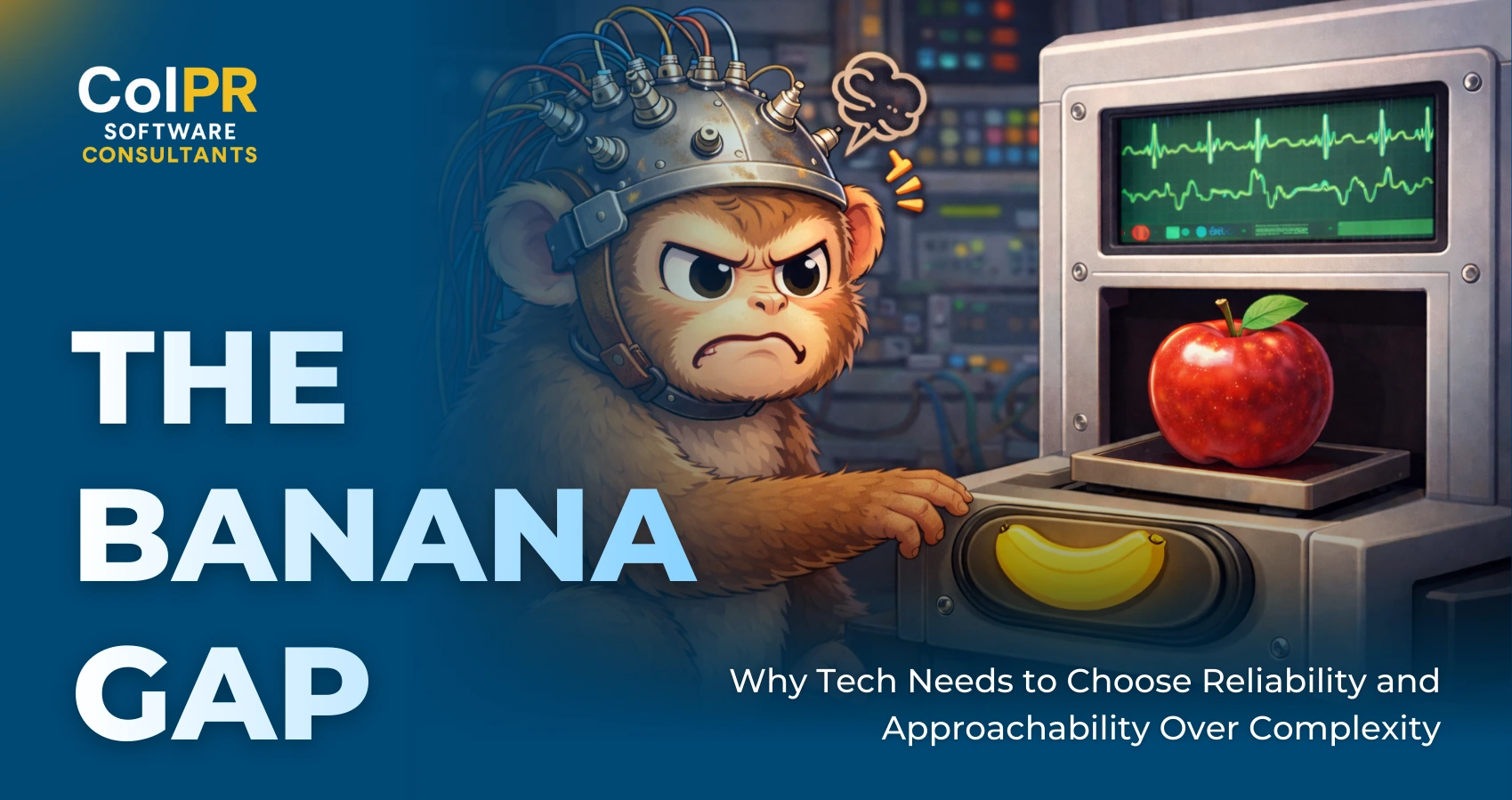
The Banana Gap: Why Tech Needs to Choose Reliability and Approachability Over Complexity
By ColPR Team
Product Management, User Experience (UX), User Interface (UI), and Sustainability
By: Ron Jones
We humans are biologically wired for a simple feedback loop: We push the button with the banana sticker, we get the "banana" down the chute. Equally, since we are still basically biological monkeys, when we push the banana button and we get "apple," we immediately throw our p-, well...our fruit dish. In this way, when a software update comes gets pushed down the pipeline, or the banana button is buried behind four sub-menus, and we can't find where the damn banana button has gone, the same damn banana button we've been pressing for 5 years, we again, throw our "fruit dish." To leave the metaphor, we'll come back to it though, what this means is circular trouble tickets, bad company reviews, horrible user experience, and general mental malaise regarding technology, and as relates to tech support interaction, loss in the faith of humanity.
We are "all in" on technology. Your great grandmother, your teachers, that one uncle you argue with at Christmas dinner, all of us. But most of us didn't choose to be and we certainly didn't all start on the same line. When I consider a pre-1997 world, I had grown up in a house of encyclopedias and many, many books. We have a terrific used bookstore in town and there existed back then many physical book retail stores and a robust public library system. The barrier to knowledge and information for many poor folks then was often simply access to words on a page. Today technology is in everything, so the barrier to accessing knowledge and information is more likely to be software that isn't accessible, or deep submenus that are so counter intuitive that they become time-prohibitive to learn just enough to access what you need. The new "information poverty" is no longer a household without physical printed words, but the interaction with opaque technology for digital non-natives.
I have to interrupt myself at this point as I just attempted to print this article and encountered a printer beep indicating an error. Because I work in tech, I was able to solve it quickly, but I am adding it to the article because it is appropriate. The issue was that my printer wants to know what kind of paper is being printed. What thickness, what material, what color. The answer 99% of the time is: 20lb bright white, 8.5x11 portrait. Printer, you knew this last week, how have you forgotten? The fact that there's no bright, identifiable button that advises the printer to "Ignore Any Paper Variables and Just Print" is emblematic of this counterintuitive design.
In my family's technology ecosystem there are what I would describe as overengineered hoops which present barriers to household happiness. Consider the Google Family Link, intended to strengthen parental control over app usage, time usage, and to restrict content to age appropriate only. But if I have to repeatedly add a child, remove a child, sign into that child's account to collect 2FA (two factor authentication), repeatedly in a loop, then finally, after nothing else works, uninstall and reinstall the original app to get the child to appear—someone has dropped the ball—or the banana button.
Consider the MS Teams labyrinth that some teachers have entered willingly and adopted wholeheartedly or that some teachers have only embraced with squinted eyes and lemon mouth. If each grade level or school has not established a standard for Teams use, a parent must dig between apps to find current assignments or missing work. I understand part of this issue is more procedural on the school's part, rather than a design flaw in the software. However; the nature of enterprise Teams and its confusing problems with sharing documents outside the organization, or saving documents in certain locations, or considerations to offline use and saving documents locally have created a mistrust and great reluctance in teachers. These issues are all also far beyond a parent's desire to learn—in this case there are many banana buttons and beneath only one will you receive your banana. So as a parent experiencing the confusion myself, I am having to search for my thrown fruit dish regularly, having yeeted it in my protohuman rage.
Consider the Nintendo/XBOX account ownership nightmare. I can't figure out who "owns" a digital license on whose profile, or with whose account it was associated and so I can't open the software. I just picture Bill Gates' voice, or maybe Phil Spencer's saying, "You can't play this right now because… (whispered) I hate you." I would say it's clear none of these executives have friends who come over to play with them. Nothing kills the party gaming vibe like being forced to stop and figure out your sign in information, then figure out who owns the game, then who unlocked the content for the game. Then you've launched the game and it needs a 30GB update. Somewhere in all those enjoyment speed-bumps the party excitement wanes and now everyone wants to drink and play on their phone. And so, the console has failed in its primary purpose: to provide enjoyment. These are some of the frictions that cause inflammation in my brain and heartburn in my belly, not to mention all the fruit-dish-throwing in my home.
Another source of friction in my work life is the functional software overlap in Office 365, where the software has become so vast and multifeatured that applications within the Suite can cannibalize each other—each one can do what the other does, only slightly worse and less intuitively. The overlap means users can struggle to figure out in which app to do the primary work because of the bounty of options available in each individual app. It reminds me of the videos of immigrants walking down grocery aisles in tears, not because of the overwhelming bounty that is available to all grocery goers, but rather the overwhelming amount of seemingly same choices so that the brain glitches and tries to reboot. Might there be a Diet version of Office 365 for those who want a simpler, more intuitive interface for banging out a document? (Don't say use Notepad because the comparison isn't fair. I remember you, WordWrap.)
Of the Security triad, many organizations have lost the plot and gone so far toward protecting the PHI or even just protecting the "Person" behind the PHI, that that person's own data is even beyond their own reach. Listen, Quest Diagnostics, or for that matter any app that wants to scan my handheld ID in my angry, shaking mitts. If I can prove myself to you with 2FA or a password, or my secret questions, why do you need more from me? I understand that when I get blood drawn, it is a very robotic impersonal interaction. But here I am in your ridiculous app not trying to apply for a mortgage or run for public office—just wanting to find out what diseases I have. Or don't have. When security measures become a barrier to access or a barrier to basic services, then the reliability, or in the triad example, the "confidentiality" has eclipsed the "availability." I paid you for the blood tests, Quest, why do I have to Ninja Gaiden sneak into your database to see the results?
I also remember the discussions of moving from hand crank windows to motorized windows in the late 1980s and early 1990s. The conversation would often end up with an oldster, usually a DIY sort of person who would say that the cost to replace the motor will be so much that people won't be able to afford to fix it, or even that it would be too complicated to do those repairs at home. I also remember smirking to myself thinking it was a silly argument when, after all, it was so cool to push a button and the glass drops into the door. The ID. Buzz came out late in 2024 and it had what I have read (I've never been in one) are touchscreen buttons for the windows. And so now I am the oldster having the same conversation in my own head about the future of those buttons or their reliability or the cost to replace them. The only reason I even know about these touch buttons for the vehicle windows is because another incredulous fruit-dish throwing monkey couldn't believe that anyone had engineered them, and some other person or persons greenlighted the design engineer. A broken crank was like 15 dollars 40 years ago. Today, a broken motor is like 500. So now let's picture a collector's showroom in the year 2096. Will there be a "classic" Toyota Corolla 2021 with a working touchscreen in that person's converted hangar/robot-proof underground bunker? (I assume we will be in a war with the synths by then and only the super elite will have the robot proof technology available to them—the rest of us will hopefully have re-engineered Cyberdyne Systems C-101.) We know that a 1960s Ford radio knob works, probably for more than a century—it's analog and tactile. A capacitive touch screen is a time bomb of e-waste. When we overcomplicate the hardware, we are building in products with a definite expiration date that consumers, and frankly the environment, didn't ask for.
Let us instead embrace Quiet Tech. In the new paradigm of Quiet Tech, innovation doesn't have to be a new feature, even if it is small. Let the innovation instead be a simplifying of the interfaces, a streamlining of the user experience. Any innovation should be invisible. SBE. Silent, But Efficient. Accessibility is not, and should never be, a buzzword for disability; it is a requirement for us all. Your grandmother, your teachers and even your uncle all need it. All who use technology, whether willingly or not. Intuition in any product should always win over central capability, particularly when adding NEW capability to an existing product. Reliability will be the new Ultimate Luxury in Quiet Tech. These are hallmarks of calm, customer-centered innovation in Quiet Technology.
Please don't give us more buttons or submenus, give us the banana when we push the old, worn banana button. Otherwise… well, I have my fruit dish ready.
Are we building software and hardware for humans to get great use of, or are we adding innovation only for the sake of the "update" button?
What piece of modern tech do you wish would just go back to the physical knob or a simple menu?
About the Author
Just another tech nerd willing to offer lifelong servitude to our future robot overlords (currently trying to get the smart fridge to make ice consistently for its meatbag family). I seek ways of making technology simply work FOR us, rather than making our lives more complicated BECAUSE of it. I had an earlier career in education where I was in perpetual pursuit of making the opaque more clear. I found that, although I loved pontificating in front of a classroom and mansplaining Shakespeare's subtle innuendo, I was not great at the day-to-day admin required. Classroom management was often like those novelty toys one could buy at the gas station in the 80s- the water wigglers - that would slip out of your hand in different ways no matter how you held them. That and keeping track of state and county paperwork that I would only discover when the front office called me to ask where the document due last Thursday was. Seven years ago I started taking my first steps into a larger world and attempting to make it more beautiful for my two brilliant daughters.